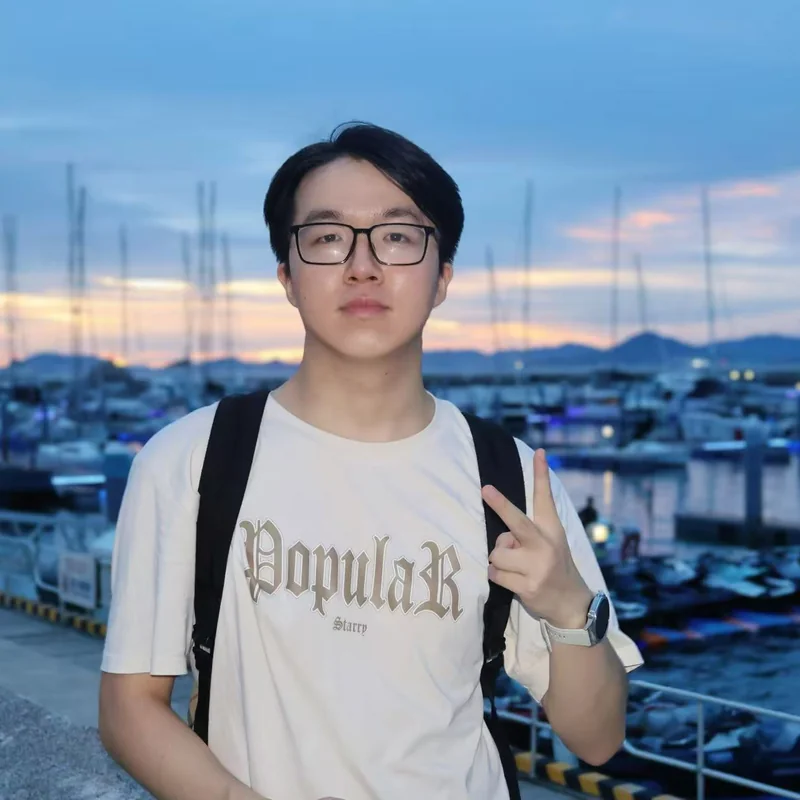
Cyrus Liu · AI4S Researcher × Builder
Cyrus Liu
Shanghai Jiao Tong University · PhD Researcher in AI for Science
I work on molecular machine learning, quantum chemistry, and research agents — and I like taking research ideas one step further, turning them into platforms and products that actually run. Current focus: D–A photocatalysts, NanoPUF, research agents, AI short-video, and AI + music.
A builder working across quantum chemistry, machine learning, and AI products26KD–A molecular-scale data production / screening pipeline~26,000 molecular systems
0.0702 eVD–A held-out test MAERMSE 0.1034 / R² 0.7575
0.977NanoPUF held-out AUC126 SEM images · pilot scope
3×National Scholarship for Undergraduates2023 – 2025 · three consecutive years
What I want to do sits where science, AI, and the real world meet
In Cyrus's own words.
I hope to keep doing deep scientific research without losing the builder's craft. I enjoy making things with my own hands, and I enjoy quickly testing whether an idea is actually worth pursuing. In the long run, whatever I work on should keep sitting at the intersection of science, AI, and the real world.
Selected work
What I am working on right now: AI for Science, research platforms, and AI products. Full list in Projects →
AI4S · 2025.12 – Present
D–A organic photocatalyst design & screening
A complete pipeline from molecular structures to quantum chemistry, machine learning, and candidate screening — ~26K molecular-scale queue.
Full research case →
Materials × Chips × AI · 2026.05 – Present
NanoPUF chip identity verification
Block-copolymer self-assembly nanoscale fingerprints + SEM + AI pairwise verification; held-out AUC 0.977.
AI PRODUCT · Cloud Alpha
ViolinSense AI · violin practice assistant
Combining generative music with real violin practice: pitch analysis, rhythm analysis, and AI-assisted practice (prototype stage).
One complete case · AI4S for D–A photocatalysis
Starting from a scientific question, connecting quantum chemistry, machine learning, data, and research workflows. Details in Research →
How can we build a verifiable AI mapping between high-cost excited-state quantum chemistry and large-scale candidate screening?
A tiered PM6 → DFT → TDDFT/Multiwfn computation pipeline and a donor/acceptor two-tower 3D molecular model that fuses low-cost electronic-structure information; the best model reaches a held-out test MAE of 0.0702 eV. Molecular registration, computation tasks, model predictions, and candidate screening are connected as the ExcitationNexus research workflow.
Key numbers
Evidence first; every metric keeps its scope and stage qualifier.
26KD–A molecular-scale data / screening pipeline
0.0702 eVD–A held-out test MAE
0.977NanoPUF held-out AUC
126NanoPUF SEM images
How I work
Define the scientific question and the validation standard first, then organise data and computation; models only take on the layers that suit them. The 8-step method is in Research →
I have a fairly fixed habit when running projects. Once a model is trained, I keep asking what comes next: can the data be better organised, can the experiments be reproduced, can the results become part of a real workflow, and can this eventually become a platform other people can use too.
A path from energy systems to AI4S
2022 – 2026: renewable-energy systems modelling → materials & machine learning → AI for Science, research platforms, and AI products. Full timeline in Journey →
2022 – 2025
Renewable-energy systems modelling
Electrolyser-array optimisation for hydrogen production: a national-level innovation project I led, plus the Cup-AWE V1.0 software copyright.
2025.12 – Present
AI for Science
Research focus shifted to molecular machine learning and quantum chemistry; three consecutive National Scholarships for undergraduates.
2026.08 – Present
Shanghai · PhD
Continuing AI for Science at Shanghai Jiao Tong University, with research, engineering, and product lines running in parallel.
Say hello
If you are also working on AI for Science, research tools, agents, hard tech — or something you genuinely care about — many collaborations don't need to start with a full proposal.