Research
Research
My research centres on AI for Science: how machine learning can genuinely enter scientific problems. Starting from molecular machine learning, quantum chemistry, and materials research, I connect scientific computing, data, models, and research workflows — and keep extending toward excited-state properties, spin chemistry, CISS, and broader computational science questions.
AI for Science research mainline
Molecular machine learning + quantum chemistry: D–A organic photocatalytic materials as the current main battlefield, connecting scientific computing, data, models, and research workflows into one chain.
Direction extensions: excited-state properties → spin chemistry → CISS → quantum-state dynamics.
How I judge research problems
01
The scientific question comes first
The core of AI for Science is still the scientific question; model metrics are only one part of the research chain.
02
Protocols and data matter as much as models
Data quality, computation protocols, and evaluation design matter as much as model architecture.
03
Enter the real workflow
I care most about whether a model can actually enter the computation, validation, and candidate-screening workflow.
04
Long-term interests
A lasting interest in quantum chemistry, molecular learning, spin chemistry, and interdisciplinary scientific problems.
I have always enjoyed putting questions from different fields side by side. Chemistry, materials, physics, machine learning, and software engineering each have their own language — but many of the genuinely interesting problems happen exactly at these boundaries. I also enjoy starting from complete unfamiliarity and slowly making sense of a field.
Research landscape
D–A organic photocatalyst design & screening · AI4S project
ExcitationNexus · molecular computation & candidate-screening platform
NanoPUF · polymer self-assembly & AI chip identity verification
Representative data, model results, and technical routes
Long case · AI4S for D–A organic photocatalysis
From quantum chemistry to AI-assisted candidate screening: a complete research narrative, not just model metrics.
How can we build a verifiable AI mapping between high-cost excited-state quantum chemistry and large-scale candidate screening?
- Charge separation and exciton binding energy in D–A organic photocatalysts are closely tied to excited-state electronic structure, but reliable evaluation usually depends on expensive quantum chemistry computations.
- Chasing model accuracy alone cannot solve the scientific problem: we also need clarity on data provenance, the relation between computation fidelities, the evaluation protocol, and how the model enters the candidate-screening workflow.
26KMolecular-scale computation / screening pipeline
0.0702 eVBest held-out test MAE
0.1034 eVHeld-out test RMSE
0.7575Held-out test R²
A multi-fidelity tiered computation pipeline
Molecular structuresD–A registration & normalisation
→
PM6Low-cost electronic structureproxy tier
→
DFTGeometry & electronic propertiesmiddle tier
→
TDDFT / MultiwfnExcited-state referencereference tier
- A tiered data-governance scheme separates the core D–A dataset from external historical data, avoiding naive mixing of sources, precisions, and uses into one training set.
- Low-cost electronic-structure proxies can be mapped comparably against high-accuracy excited-state references.
- The current data-production and candidate-screening pipeline is expanding to ~26,000 molecular systems, providing the computational base for later high-throughput virtual screening.
Donor / acceptor decomposition + 3D molecular learning
DONOR BRANCH
Donor fragment · 3D molecular representation
Donor – acceptor representation interaction & fusioncheap proxies injected: PM6 HOMO / LUMO / frontier gap
Prediction of exciton binding energy & excited-state properties
ACCEPTOR BRANCH
Acceptor fragment · 3D molecular representation
- Exploiting the natural two-fragment structure of D–A molecules with a donor/acceptor two-tower 3D molecular model, so donor and acceptor representations keep their structural roles through interaction and fusion.
- Low-cost electronic-structure information — PM6 HOMO, LUMO, and frontier-orbital gap — is introduced to test how much cheap quantum proxies add to property prediction.
- The current best model reaches a held-out test MAE of 0.0702 eV, RMSE 0.1034 eV, R² 0.7575. The research focus is not only "lower MAE" but understanding which low-cost physical information contributes gains stably.
ExcitationNexus
- Connects molecular registration and normalisation, computation-task management, result parsing, feature construction, model prediction, and candidate ranking into one research workflow.
- Structured records reduce the version chaos of molecular structures, computation files, feature tables, and predictions scattered across directories and scripts.
- The platform is positioned as a research-workflow and first-pass screening aid — it does not replace high-accuracy computation or experimental validation.
For this task, the more valuable direction is combining low-cost electronic-structure information, 3D molecular representations, strict evaluation protocols, and computation workflows. Next steps: multi-objective excited-state properties, uncertainty / OOD, active screening, and research on spin chemistry and CISS.
Why this case represents how I do research
- Break down the scientific question and its computation cost first, then decide which layer AI should enter — instead of picking a model first and hunting for a task.
- Treat negative results as research information: which cheap features worked, which model routes were not worth continuing — don't keep only the successful experiments.
- Close the loop between data governance, computation, models, evaluation, and the platform, so one model experiment becomes reusable infrastructure for the next round.
Papers
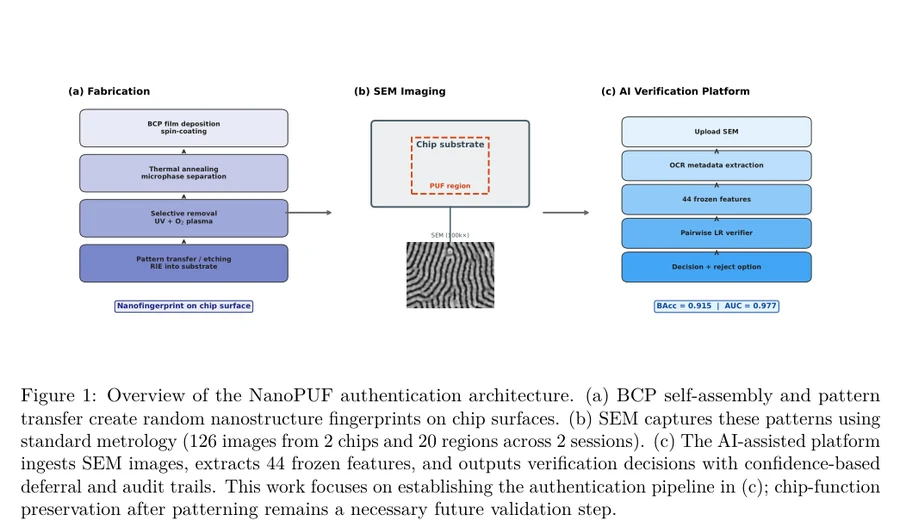
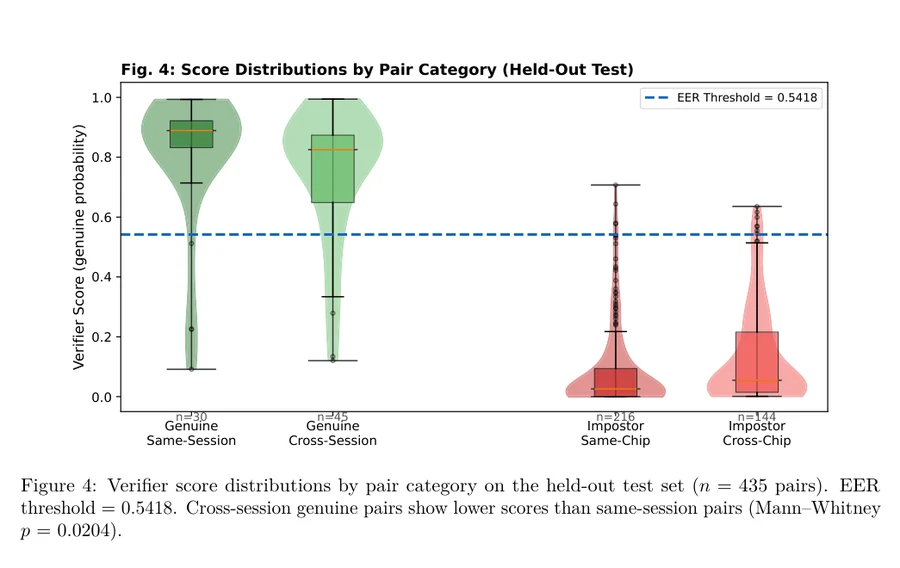
NanoPUF Authentication from Block Copolymer Self-Assembly SEM Images: An AI-Assisted Pilot-Scale Validation and Security Boundary Analysis
Using block-copolymer self-assembly SEM nanoscale fingerprints as a physical entropy source, this work builds a full computation pipeline — image ingestion → metadata extraction → frozen features (44-dim single-image / 88-dim pairwise) → leakage-controlled pairwise verification → calibration and rejection options. Held-out test balanced accuracy is 0.915 and AUC 0.977, with verified properties explicitly separated from unverified ones (clone resistance, replay resistance, modelling-attack resistance, long-term drift).
Predicting Donor–Acceptor Organic Photocatalyst Properties (Engram-EScAIP)
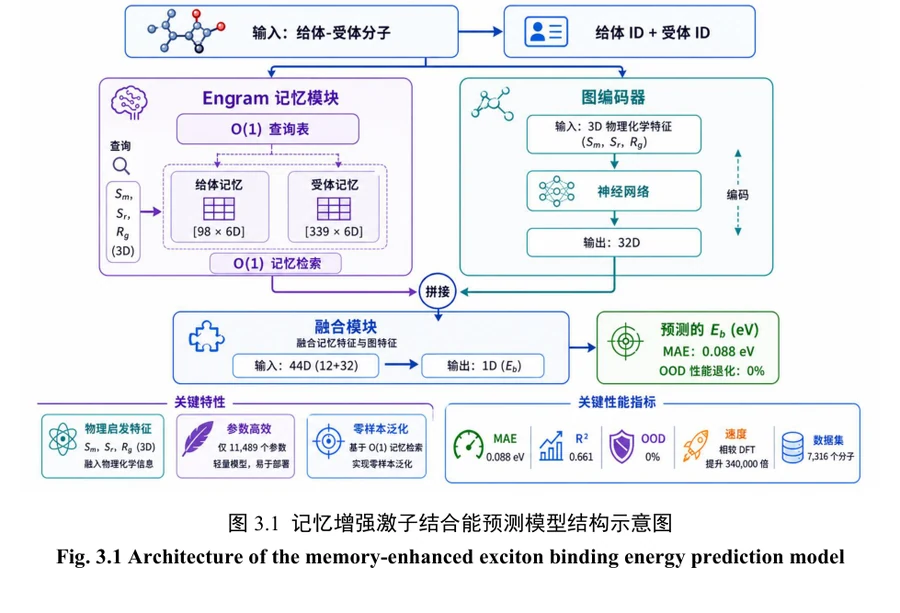
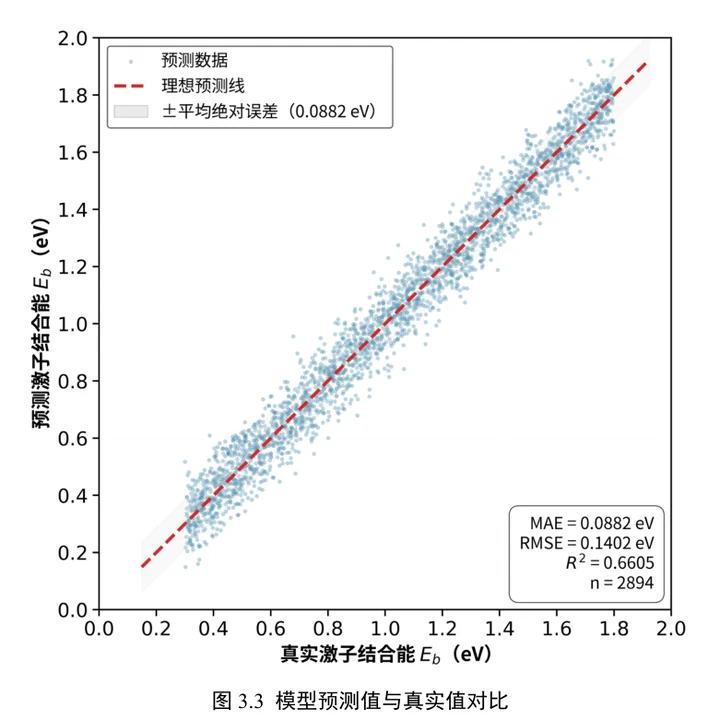
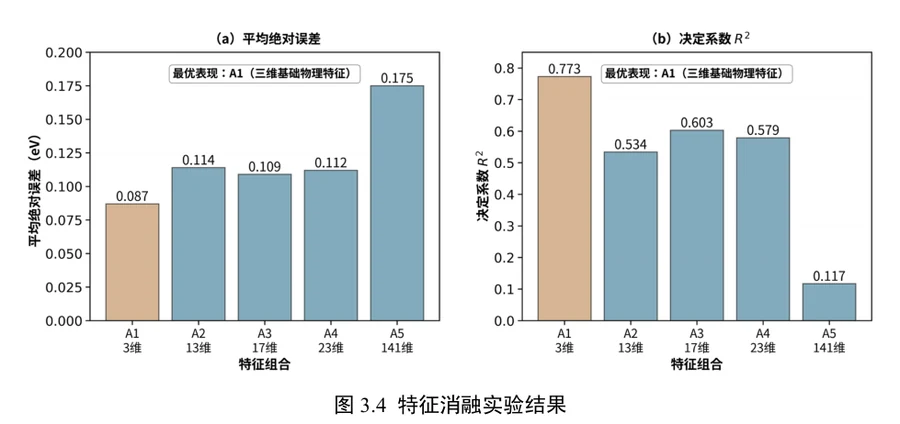
This earlier-stage thesis built a 7,316-combination D–A molecular dataset (93 donor × 323 acceptor fragments) with a donor/acceptor fragment-memory mechanism (Engram-EScAIP), reaching a random test-set MAE of 0.0882 eV; it also prototyped the ExcitationNexus system, connecting molecular management, structure generation, computation-task tracking, result parsing, and model prediction into one workflow.
How I work
Define the scientific question and validation standard first, then organise data and computation; models only take the layers that suit them; results end up in a trackable, reusable workflow.
01
Problem definition
Translate research goals into computable, verifiable problems: target quantities, scientific hypotheses, cost constraints, and "what result would actually count".
02
Data & protocol
Check data provenance, computation accuracy, label generation, and leakage risks; freeze the evaluation protocol before comparing models.
03
Computation assets
Build the right computation hierarchy for the question (PM6 → DFT → TDDFT/Multiwfn) with clear boundaries between low-cost proxies and high-accuracy references.
04
Models & ablation
Start from simple baselines, then add 3D representations, fragment structure, or low-cost physical features; use ablations, negative results, and held-out tests to judge whether gains are real.
05
Reliability checks
Attend to OOD, error distributions, thresholds, and rejection / deferral — not just a single averaged metric.
06
Workflow platformisation
Put data, computation tasks, features, model versions, results, and audit records into a trackable system, reducing dependence on scattered scripts and personal memory.
07
Candidates & validation
Use model outputs for ranking, first-pass screening, or prioritisation — always as an assist layer, with high-accuracy computation and experiments as the final validation.
08
Review & next round
Record which routes worked, which failed, and what data and experiments the next round needs most, so each research iteration accumulates into a long-term asset.
Principles for research agents / AI tools
AI-assisted, verification-first.
- Use agents for task decomposition, literature triage, code and experiment organisation, result checking, and repetitive work — never treat unverified generated content as a scientific conclusion.
- For complex development, work goal-driven with minimal changes, verification checkpoints, and transparent handling of uncertainty; keep auditable records of model, code, and data operations.
- For long projects, accumulate reusable skills and workflows so the next round of research spends less time rebuilding environments, finding files, and restoring context.
Interested in this research?
AI for Science, molecular machine learning, quantum chemistry, research agents — always happy to talk.